Showing posts with label LCB at Home. Show all posts

Cheese Soufflé, Trout, Cherry Flan : Lesson 15 : Le Cordon Bleu at Home

It's a lazy week so only one posting about the dinner.

On Wednesday it was:


Soufflé au Comté : Cheese Souffle

Truite de Mer, Sauce Verte : Whole Poached Salmon Trout with Herbed Mayonnaise

Clafoutis aux Cherises : Cherry Flan


This one requires equipment: a fish poacher (pan) would be useful and a souffle dish would help. Alternatives: a roasting pan instead of a fish poacher and an angel food cake pan instead of a souffle dish. But both these specialty items were acquired and the project carried on.

It turned out that Comté cheese is hard to come by (it's a great, delicious, tangy French cheese) but Gruyere is a viable substitute. Alas, the cheese shop wrapped a Havarti piece instead of the gruyere (I have know idea how that confusion happened) so neither Comté nor Gruyere were used - - luckily Havarti works fine too (hey... so would cheddar).

And the Salmon-Trout was difficult to get in the required size (limited by the size of the fish poacher pan). Real Salmon would be too big and there were to be 8 people at dinner (eventually turned out to be 10) so a fair amount of fish was needed. I bought 3 trouts at a kilo (2 lb) apiece.

Soufflé au Comté : Cheese Souffle

It assembles easily. It's a béchamel sauce with egg yolks and cheese in it then folded with beaten egg whites. Simple, really. It rose very well. Since it's fragile (and deflates) once out of the oven the picture is of it while still in there.

souffle 160720081501

Shockingly tall. Excellent. It held up quite well once removed from the oven and did not collapse immediately (it took a full 3 or 4 minutes). As for flavour... very light and tasty.

The top is rather too brown, just short of being burnt, because it was left on the "convection" setting accidentally and the swirling air over-browned the thing. No harm done except that people were inclined to ask if it was a Chocolate soufflé.

Truite de Mer, Sauce Verte : Whole Poached Salmon Trout with Herbed Mayonnaise

This we called the "Fish Disguised as a Fish".

trout 160720081497

Wrapped in cheesecloth, poached in a "Court Boullion", a little over-poached in fact (the head was too loose and fell off) - - cooled, the skin peeled off and replaced with decorative cucumbers - using a herb mayonnaise as the glue for the cucumber scales.

Court Boullion is a herbed wine & vinegar mixture; much more flavourful than poaching in water.

The Herbed Mayonnaise came off without a hitch (I often mess up when making mayo - don't know why). I used 2 egg yolks, light olive oil for a more delicate flavour. Then you add chopped spinach and watercress to make it green. Very nice taste and it looked good with the cucumbers.

Clafoutis aux Cherises : Cherry Flan

Then, dessert, simple as well... cherries (pitted, fresh, whole) covered with what amounts to Crépe batter and baked in individual little dishes.

Clafoutis 160720081500

No tricks here, no trouble, just plain tasty. Luckily it happens to be cherry season.

Foie de Veau : Sautéed Calf's Liver : Lesson 14 : LCB at Home

This was a tough one (not literally). Liver's not a favorite of anyone I know. Alas, this dinner won't cause anyone to convert.

Other than the liver (which was, in reality, not horrid), it was good eatin'.

Coquilles Saint Jacques Dieppoise : Scallops with Mussels and Shrimp in Cream Sauce

Scallops 090720081482

This was very popular - fish soup more or less. Perhaps it wasn't meant to be and the "sauce" should have been thicker. You can see that it had oily spots on top too, which means that it wasn't properly emulsified and maybe the cream/sauce was about to separate. Thus, despite the less than ideal appearance the flavour was great. Honestly, one can't go far wrong with a combination of shrimp, mussels, mushrooms and scallops in a cream sauce.

All the stuff can be prepared in advance (hours) and put together and heated with the sauce a the last minute - very convenient.

Yes, that's a sprig of parsley on top; tacky, I know, but I have a ton of parsley growing in the garden and really must do something practical with it - step 1... decorate stuff.

Foie de Veau au Vinaigre et aux Deux Pommes : Sautéed Calf's Liver with Roasted Apples and Potatoes

What can I say? It's liver. So, put a sprig of parsley on top and hope for the best.

liver 090720081486

It would have been great to get full sized (not thinly sliced) liver. These thin ones are touchy to fry (sauté). It worked just fine; 1 minute 30 in one side (high heat) and 1 minute on the other side. They remain a bit pink in the middle and were very good - given that it's liver.

Then the sauce; interesting. - one part apple cider vinegar to two parts veal stock and deglaze the pan. Reduce until saucy. Ends with a slight acidic vinegar touch to a sort of sweet tasting sauce. Works very well with the veal.

The hit of the evening was the roasted apple and potatoes. Golden Delicious apples, peeled, cored, cut in 6ths; toss (fry) in hot butter and oil then roast at 450F for 15 minutes. Do the same with potatoes, but for 30 minutes (they said to boil them first but I forgot - so I simply fried them for a bit longer than planned before they went into the oven for roasting). That's the apples on the outer ring and the potatoes piled in the center - they look rather alike.

roasted 090720081480

Soupe de Fraise Cécile : Fresh Orange Ice Cream with Strawberry Sauce

A great dessert from the chefs at Le Cordon Bleu.

orange 090720081488

Orange Ice Cream on a puddle of strawberry coulis (just blended strawberries and powdered sugar) with chunks of berries. A great combination.

The fresh orange juice ice "cream" was made without cream. It's more or less the same procedure at the famed Crème Anglaise that we've done so often - but with orange juice instead of cream. Next time I will double the recipe to make a whole liter [quart] because it disappeared in a flash.

donvier 100720081490

The fine folks at Donvier were kind enough to send me a new, gratis [no charge], paddle that had given out on this ice cream machine. Very kind of them; they made a happy customer out of me and happy ice-cream-consumers out of 5 other people. An ice-cream maker is great fun and surprisingly easy to use. A good return on investment too.

Scallops, Beef Liver, Ice Cream : Lesson 14 : Le Cordon Bleu at Home

foie de  veau 242527896_6d31d06464_b
Thanks to Robyn Lee for the picture of a Foie from Paris

Wednesday's dinner will be:


Coquilles Saint Jacques Dieppoise : Scallops with Mussels and Shrimp in Cream Sauce

Foie de Veau au Vinaigre et aux Deux Pommes : Sautéed Calf's Liver with Roasted Apples and Potatoes

Soupe de Fraises Cécile : Fresh Orange Ice Cream with Strawberry Sauce


There's Cointreau in the ice cream - but there's not any cream so it's really a sorbet I think. The recipe is essentially a Crème Anglaise, made the same way, but made with fresh squeezed orange juice instead of using milk or cream - - then frozen up as ice cream. Great for the lactose intolerant.

The foie recipe called for is calf's liver; the Portuguese Butcher down the street calls theirs "beef" liver (generically) thus we will have beef liver, not calf's & not veal liver; I wonder if it qualifies as calf's liver though. Really, who would eat anything but calf's liver - as an old cow liver is not likely to be very nice.
It's supposed to be served with "turned" [shaped] potatoes and apples but probably I won't be "turning " them.
Getting guests for this dinner proved trickier than the other 13 times - likely 'cause Liver is the theme and many have not such a good impression of it. Count me as one of those.

The starter is scallops with shrimps and mussels and mushrooms. Doubling up on the mussels would be a good idea; the mushrooms too maybe.

Duck with Garlic, Tomatoes and Olives : Canard à la Niçoise : Lesson 13 : LCB at Home

Today there were a few deviations from the recipes; this will be occurring as confidence builds while executing these lessons. 

Daurade Crue à l'Aneth : Marinated Sea Bream with Fresh Dill

Salmon Marinated 020720081453

It started out as Sea Bream but since I'd done the same recipe with Salmon in class in Paris we figured to go with the cheaper/more colorful option.  Layered between a mix of lemon and lime juice, shallots (very finely and neatly diced), olive oil, salt & pepper and a few hours to marinate.  Quite a success.

Salade d'avocat : Avocado Salad with Tomato

Unexpectedly (not mentioned in the menu listing) was a veggie salad to accompany the fish.  It's simply diced avocado mixed with some lemon juice, olive oil, and salt & pepper; with diced tomato and a few decorative leaves of lettuce underpinning it and some decorative dill on top. It's all very '70s looking. And surprisingly tasty for something so simple.

Avocado Salad 020720081450


Canard à la Niçoise : Duck with Garlic, Tomatoes and Olives

The star of the show.  Delicious.  But there's not a lot of meat on one of these; I was worried that there wasn't enough for 6 people.

When preparing the duck remember to remove the wishbone (at the neck end); it makes the cutting of the meat ever so much easier.

Followed the recipe as written more or less (see the book: Le Cordon Bleu: At Home) except for two things:

1) I could not get a duck like the ones in France so we went over to Chinatown and got a nice fresh one there; as a result the tail end could not be trussed shut (as you can see on the right of the picture [compare to the picture in Marinated Fish, Duck, Crepes : Lesson 13 : Le Cordon Bleu at Home).

and 2) triple the use of cloves and don't discard them at the end

and 3) I didn't cook the whole thing on top of the stove. In cooking school and in professional kitchens the finishing of the dish is almost inevitably done in the oven; it's cooked in a covered casserole so why bother taking up space on a burner or two - better to get it out of the way.  Bring the thing to a boil on top of the stove and then stick it in a hot oven.
Some day I'd like to try this in the sous-vide manner - maybe 65C [145F] for a few hours.

well... also 4) I cooked it for an hour and then removed it from the stove to go on "standby" until dinner-time was closer.  Did the last half hour in a 350F [175C] oven to get it back up to temperature and finish it off.
I would have been better off cooking it for 40 minutes at first and then 30 at the end; the meat was very nice but would have been even better if it was a bit less "done".

oh, and...  5) I did not deglaze with cognac but with Brandy from Jerez (Spain); also delicious and much more reasonably priced.
Duck Nicoise 020720081454

Crêpes à la Gelée de Groseilles : Crepes with Red Current Jelly

Another major change to the recipe.  No red currant jelly.  It's strawberry season so let's exploit the opportunity.

Make the crepes (the sweet sort), sprinkle the "inside" with Cointreau, roll 'em up, line either side with 'berries and dust with powdered sugar.  These were very popular and a nice light finish to the meal.
Crepe 020720081459

Note:  Also served were some green beans (there are never any vegetable dishes in French cuisine) and a few baked potatoes (since the oven was on anyway).

Marinated Fish, Duck, Crepes : Lesson 13 : Le Cordon Bleu at Home


Wednesday's dinner will be:


Daurade Crue à l'Aneth : Marinated Sea Bream with Fresh Dill

Canard à la Niçoise : Duck with Garlic, Tomatoes and Olives

Crêpes à la Gelée de Groseilles : Crepes with Red Current Jelly


That's the menu as called for in the book (that being... Le Cordon Bleu: At Home) but there will be some little changes (with the passage of time and experience with the book we're becoming less pedantic).

Probably it'll be Marinated Salmon instead of Sea Bream; because that's what we used when I did this dish in school and it's loads less expensive. There will be more than the requested two (2) cloves of garlic in the duck (looove the garlic). The crepes will probably have something other than red current jelly on them since it's not so popular around here (I'm thinking maybe... Cointreau (Le Cordon Bleu is, as an aside, presided over by André Cointreau of that very family).

Veal Fricassee et al : Lesson 12 : LCB at Home

The dinner was:

Oeufs Mollets Florentine : Soft-Boiled Eggs with Spinach and Mornay Sauce

Better known as "Eggs Florentine".  Simple enough but we deviated from the recipe (the book: Le Cordon Bleu: At Home) because the spinach they have in France must be different than what we get here in Canada.  Here it is evidently more tender so boiling it to death, as called for in the book, would be overdoing it.  A bit of a steam in its own moisture was enough to do the base of spinach.  Note: Wring out the spinach well to avoid pooling liquid in the bottom of the dish.

The "recipe" for soft boiled eggs didn't work as expected.; they were not soft enough for a European palate - - not runny at all. The book calls for putting the eggs in cold water then back to a boil and then simmer for 5 minutes; a simmer for three (3) would have been better I think.

The Mornay Sauce on top was a old favorite from Choux Puffs : Lesson 7. Then it's under the broiled briefly to color them up a little bit.   This is an excellent dish.

Florentine 250620081430 

Fricassée de Veau aux Poivrons Rogues : Fricassee of Veal with Sweet Peppers, Tomatoes, and Olives

Ah, the veal.  Again with the Veal Shoulder; apparently a versatile meat - and inexpensive too boot.

Better known as "Veal Fricassee". That's basil on top of it; a pleasant variant of the usual decorative parsley; and there's some in the dish as well .  The directions always say to make "2 inch cubes" of meat [5 cm] and I can never bring myself to make chunks that huge - - but this time I tried.  They probably came out mostly at an inch and a half [1 1/2"; 3,5cm] so I'm working my way up towards the "proper" size.  The suspicion is that the meat-chunk size affects the cooking process so it might turn out to be important.

Also made the Fond de Veau Brun : Brown Veal Stock in preparation for this dish.  The butcher had no veal bones so regular beef bones were used - which seemed to work out okay.  Went by the recipe (well, a 1/3 sized recipe) but would have been better off browning the bones at 400 F instead of 500 F (it got a bit smoky there for a while).  Another book has you put the veggies in to brown as well and that is, as I recall, how we did in class - the bones on a bed of veggies.  A longer simmering time for the stock, up to 5-6 hours, wouldn't hurt either.

Fricasee 250620081435

As for the Fricassee... the color is a bit pink hued in the meat because of the red peppers in the sauce so that gives an interesting look to the dish. It also has black and green olives (pitted) and, as I mentioned, basil in it; an unusual combination.

I chopped the onion, green pepper, tomato, and red pepper up in fine brunoise [dice] in my best "professional" fashion.  Very tiny so that they'd become nearly invisible in the sauce and therefore less easily discoverable by certain, young, very particular [picky] eaters - - seems to have worked.

And… I cooked the meat for the full length of time recommended in the recipe since I had come close to cutting the pieces to the proper size: the meat came out quite fine, than you.  I shall mention too that I did not fanatically trim all the silverskin from the meat.  I removed anything that might be gristley or unpleasant but was much less fanatic about taking off every little bit of non-red stuff - - in expectation that it would all reduce or dissolve with the new, longer, cooking time.  The plan seems to have worked.  The meat was very good, tender, and had no tough bits remaining by the time the cooking was all done.

Pâtes Fraîches : Fresh Pasta

The first time I ever made fresh pasta at home; although I'd done it in school in Paris.  Used the Kitchenaide to mix the ingredients, kneaded by hand and used a hand-crank machine to squish and cut the noodles.  It all worked quite well.  Advice: use liberal amounts of flour on the surfaces of the machine to prevent sticking when rolling and cutting; get help "catching" the pasta as it come out the bottom of the machine; dust it well with flour when drying; and, finally, string up some kitchen twine or something as a clothesline to hang the noodles on to dry - much more effective than lying it out on kitchen towels I think.  If using kitchen otwels to dry the pasta you'll need at least two (2) towels.  I started with one and it quickly filled up (do not overlap fresh noodle layers).

This pic is just the pasta tossed, as recommended, with some butter (and a bit of oil).

Homemade Pasta 250620081437

Riz à l’Impératrice : Empress Rice Pudding

Take a Bavarian Creme and add rice cooked partially in milk.  Spout, in this case, berry sauce over it (leftover from last week - no need to make the glaze specified in the book).

Rice pud 250620081440

This does not make great leftovers; the rice gets somewhat gelatinous the second day.


That's it. The whole deal in one go.

Eggs, Veal Fricassee, Rice Pudding : Lesson 12 : Le Cordon Bleu at Home

Wednesday's dinner will be:


Oeufs Mollets Florentine : Soft-Boiled Eggs with Spinach and Mornay Sauce

Fricassée de Veau aux Poivrons Rogues : Fricassee of Veal with Sweet Peppers, Tomatoes, and Olives

Riz à l’Impératrice : Empress Rice Pudding


Served with Pâtes Fraîches : Fresh Pasta according the book (where they slip a "serve with" suggestion into the last paragraph of the instructions for the entrée - which often is another dish someplace in the book and requires additional shopping/work/learning/effort).

Soft boiled eggs - a cinch; with normal enough done sort of spinach and a Mornay sauce we've seen before.

Fricasee is a veal stew thingy; like some recent veal dishes but the meat is browned first and then they toss in an opportunity to make Fond de Veau Brun : Brown Veal Stock from scratch - what fun. The recipe for the stock makes 12 Cups of which one (1) cup is used in the stew. Errgh. I believe that we might make only a one-third recipe of stock.

Lastly, a rice pudding that's yet another Bavarian Cream thing but with rice in it. We'll omit the candied fruit ingredients because they are generally disgusting and stick to my teeth.

Thus, there are really at least five (5) recipes in this week's adventure. It'll be great.

Sole Belle Meunière (and More) : Lesson 11 : LCB at Home

Here's the pictures and commentary.  I'll omit recipes this week becasue by now you have the book, I'm sure.

Petits Légumbres à la Greque : Marinated Vegetables with Lemon and Coriander

The essence of this vegetable "salad" was to cook and then cool all the vegs in a wine, olive oil, water, coriander and black peppercorn marinade, separately - - and then serve them separately too.  It came out very well - quite tasty. But it was too many vegetables for 6 people; I'm guessing the book's got a misprint on the amounts in this recipe.

Here's two pictures because there were so many bowls of them:
veg1-180620081410
Mushrooms, artichokes, asparagus,  pearl onions

Veg 2 180620081411
Leeks, carrots, cauliflower

There were way too many veggies for the table, cut the quantity on carrots back to a half pound [1/4 kilo], use a 1/4 head of cauliflower, 1/2 kilo [3/4 pound] mushrooms.  That, and we added asparagus, which was not in the official recipe, becuase they looked so tasty in the shop.

Sole Belle Meunière : Pan-Fried Sole with Nut-Brown Butter and Mushrooms

This is delicious but my plating was a little sloppy; therefore the picture's confused too.
sole 180620081417
This would have looked great on a long, rectangular plate; with the filets slightly overlapping, the mushrooms ranged along one side of the plate and the lemons on the other... something like that.  But it's not.  What I've got instead is a round plate and...there's a simple pan-fired sole, decorative lemons on it, a lemon / butter sauce over the sole and some fried mushrooms to top all that; dropped on some lemon wedges too.

The fresh Dover sole was salted, peppered, dredged in a dusting of flour and then fired in a very hot pan in butter and oil - maybe 2 minutes a side.  Simple, delicious. We also did a couple of Basa filets (that's a sort of catfish-like fish) exactly the same way (those, of course, took a bit longer to cook 'cause they're much bigger and thicker) - - those were also delish; more highly praised than the sole as a matter of fact.

Dover Sole is quite hard to come by, fresh.  Use frozen or some other fish works just as well.

Cygnes Chantilly : Choux Pastry Swans

The other pastry swan picture was better (see: Vegetables : Sole : Pastries : Lesson 11 : Le Cordon Bleu at Home) but I don't want to repeat it.

swanx180620081420

These are filled with Chantilly cream (whipping cream).  The fun was to construct these at the table after dinner (the choux body was baked and the necks baked but we hadn't assembled the pieces into swan shapes yet).  The whole group pitched in and cut choux, trimmed wings, filled the bodies, stuck on the necks and wings.  Then ate them.

When making the necks a couple of neck shapes snapped (broke) while being freed from the pastry sheet.  These were glued back together with a dab of egg-glaze on the broken ends of each piece and stuck back in the oven for 2 minutes for the egg to "set" and adhere the two fragments together.  Saved!  Another approach would be to make about 15 neck shapes for each swan body the you have.  Allow for failures.  Also, grease the pastry sheet really really well.


That's it for last week's dinner.  Short(ish) and fast because I don't have time to do three entries for the meal;  I wouldn't get them finished before starting on the next set.  Gradually getting further and further behind.  Better, I think, to have the pictures and commentary than the recipes anyway. 

Vegetables : Sole : Pastries : Lesson 11 : Le Cordon Bleu at Home

The menú as published:


Petits Légumes à la Grecque : Marinated Vegetables with Lemon and Coriander

Sole Belle Meunière : Pan-Fried Sole with Nit-brown Butter and Mushrooms

Cygnes Chantilly : Choux Pastry Swans


swans 180620081422

The English versions of those dishes' names are much too long and descriptive. I'd prefer "Vegetables a la Grecque", "Sole Meuniere with Mushrooms" and "Pastry Swans".

There was an accompaniment of "English" Potatoes (that's "boiled") and an Onion Tart to go along with this dinner; a number of young people were guests and appetites were expected to be sizable.

Chilled Cream of Potato and Leek Soup : Crème Vichyssoise : Lesson 10 : Part 3 : LCB at Home

Neither this nor the Rice Pilaf are about to produce anything in the way of interesting pictures; alas. Between that and the fact that the soup was dug into prior to the picture being took gives me this…

leek soup 110620081382

It was very decorative before the ladle-ing.

I did this recipe at an Italian restaurant I worked at; it was pretty much the same: leeks, onions, potatoes, water, some dairy, salt, pepper - simple enough.  And lovely, served cold on a warm summer evening.

What I did was…


Crème Vichyssoise : Chilled Cream of Potato and Leek Soup

Serves: 6

Ingredients

  • oil
  • butter
  • 6 leeks, medium, the white part, chopped
  • 2 onions, medium, chopped
  • 3 potatoes, baking, chunks
  • 6 C chicken stock
  • salt
  • pepper, white, fresh ground
  • 1 1/2 C crème fraiche
  • chives, fresh, cut, for garnish (and flavour)

Procedure

  1. Oil, with maybe a little butter, into a pot , leeks & onions in too - medium-low heat
    • Cook until soft but not colored
  2. Add stock and potatoes, simmer
    • until very soft (15 minutes, maybe)
  3. Purée with a stick blender (best) or in batches in a blender-blender
  4. "Temper" 1 C of crème fraiche with a couple of tablespoons of the purée
  5. And then the cup of crème fraiche into the pot of purée
    • Salt and pepper to taste (please, use enough salt)
    • Allow to cool and then into the fridge for a couple of hours
  6. After it's cool check the salt and pepper again - it probably will need a touch of pepper
  7. Finish, upon serving, with the rest of the crème fraiche and some chopped chives

Notes

  1. At the restaurant we didn't use crème fraiche; we used 1/2 cream and 1/2 2% milk
  2. Some cut the potato down to just one spud - and it's good with more leeks; but leeks are blindingly expensive here in Toronto thus we'll not be doing that.

Apple Tart : Tarte aux Pommes : Lesson 10 : Part 2 : LCB at Home

The French like to do this fancy, curvy, apple-slice decoration on top of their apple pies.

apfeltart110620081387

It looks lovely. Nitty to put on, but lovely. And it has a classic apricot glaze to finish it off.

Tasty as can be. The dough/shell is delicious tasting but... it was a little on the tough side. Hard to penetrate with a fork; and the edge was quite browned (but not burnt). The toughness is almost certainly from overworking the dough during its preparation; they warn you about this problem. I used a machine to make the dough and evidently went a trifle too far when blending it. This is a "brisse" crust so it's a crumbly mess when it's still dough, waiting to be formed. In the machine this time it suddenly decided to form itself into a ball and that was evidently too too much for the poor pastry. It was not. by any means, horrible - - but must be better next time.

What we did was...


Tarte aux Pommes : Apple Tart

Serves: 8

Ingredients

  • 1 pâté brisée sucrée (sweet crusty pastry)
    • 1 1/2 C flour (minus 1 T)
    • 3 T sugar
    • 7 T butter
    • salt, pinch
    • 1 egg
    • 1 t vanilla
    • 1 T water (maybe)
  • Apple filling
    • 3 apples, Golden Delicious (get 6, just to be sure) - peeled, cored, chopped
    • 3 T butter
    • 3 T sugar
    • 1 T vanilla extract, pure, natural
  • 2 apples, Golden Delicious (yes, more apples, for the spirals) (maybe 3 apples, have an extra one ready)
  • Glaze
    • 1/2 C Apricot jam
    • 1 T water
    • 1 T kirsch

Procedure

  1. Make the tart shell
    • See the procedure for the recipe of the Onion Tart: Tarte à l'Oignon : Lesson 6 but use the ingredient list above (more sugar and some vanilla flavour)
    • "Blind" bake the shell and cool it (see that other post about that too)
  2. Apple filling
    1. Sauté, without any crusty browning, the chopped apples in the butter until very very soft (covered occasionaly )
    2. add the sugar and vanilla
    3. continue cooking until rather dry and sticking together - not runny - and set aside
  3. Peel, core, halve and slice very thin the
  4. Put filling in (cool) shell, decorate with 1/2 slices in spirals
  5. Bake at 175 C [350 F] for 30 minutes (until apple slices are softer and their edges are toasting)
  6. Melt apricot jam in a tiny saucepan, whisk in water and kirsch
    • cook until syrupy
  7. Paint glaze onto the pie

Done

Notes

  1. Take great care not to overwork the pastry. It ought to be crumbly, not formed into a ball.
  2. If the edge of the pastry crust threatens to become too dark cover the edge with strips of alu foil.


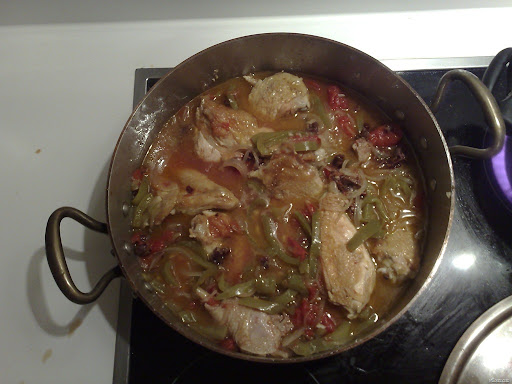
Chicken Basque Style : Poulet Sauté Basquaise : Lesson 10 : Part 1 : LCB at Home

As previously mentioned, this one's an old favorite. Also great for pot-luck suppers, keeps well, good cold, reheats alright, not pricey - all the characteristics of a regular family dish. Make it often.

basque 110620081384

The plating is, bottom-up: fried prosciutto (Italian air dried ham - should have been Iberian ham but that's hard to find). The vegetable mix (green peppers, onions, tomato), the sautéed chicken, topped with the reduced cooking liquid (essentially a tomato/green-pepper sauce).

We had a large free range chicken and cut it in 8 pieces but the breast portions were in fact oversized (not necessarily a bad thing) meaning that they took longer to cook than the other pieces.

So anyways... what I actually did was:


Poulet Sauté Basquaise : Chicken Basque Style

Serves: 6

Ingredients

  • 2,25 kg chicken [5 #] cut neatly in 8 pieces (8 if you keep the little wings - I did)
  • salt
  • pepper, white, freshly ground
  • olive oil
  • 1 T butter (helps the browning apparently)

  • 2 onions, medium, julienne [fine slices]
  • 6 green peppers, large, julienne (½ kg [¼ #]) (a length similar to the onions please)
  • 4 garlic cloves, crushed

  • 1 C stock, approx
  • ¼ kg tomatoes [3 big ones] peeled, seeded, brunoise [diced] (I used a can due to the current tomato/salmonella scare)
  • 1 bouquet garnis [herb packet] (celery, thyme, parsley, bayleaf, whole peppercorns)

  • 150 gr very good ham, dry cured, slices [5 oz]

Procedure

  1. If you have a whole chicken… cut it up; salt & pepper the pieces
  2. Oil into a pan, medium high; fry pieces really well - more than you usually do. You want these good and brown. Fry the larger pieces longer so they'll be pre-cooked more
  3. Meanwhile
    • Crush the garlic
    • Devein, deseed and julienne the green peppers
    • Julienne, very finely, the onions

  4. Remove browned chicken from the pan; put in the veggies & garlic, stir
    • Maybe add some oil if there doesn't seem to be enough chicken fat
  5. Cover, cook on medium-low until they're soft but not browned, stirring occasionally
  6. Add back the chicken pieces and their juices
  7. Add tomatoes, bouquet garnis and stock (to just cover)
  8. Bring to a boil. Reduce to a simmer. Cover the pan and simmer until done/tender (about a half hour or, perhaps, 30 minutes)

  9. Remove chicken again and, separately, pretty much all the vegetables. Toss the bouquet garnis out
  10. Meanwhile, a little oil into a pan and fry the slices of ham slightly (this is not bacon we're talking about)
  11. Reduce the chicken cooking liquid until it's saucey; coating the back of a spoon

  12. Place the ham slices neatly on a plate (around the edge, maybe), arrange the vegetables inside that, top with the chicken, and pour sauce over the whole lot

Done

Notes

  1. As always, these recipes are sourced from my copy of - Le Cordon Bleu: At Home

Vichyssoise, Basque Chicken, Apple Tart : Lesson 10 : Le Cordon Bleu at Home

It's getting easier. I've made this one before. Here's a picture from way back then.

14102007687

See: Basque Chicken: Poulet Sauté Basquaise: Pollo Escuaro (Basque, Vascongado).

I've made the "starter", Vichyssoise, a few times in the Italian restaurant where I worked and the rice too. The dessert is a variation on an old favorite as well. This will be a sort of "old home week". Should be a breeze.

The menú is:


Crème Vichyssoise : Chilled Cream of Potato and Leek Soup

Poulet Sauté Basquaise : Chicken Basque Style

Riz Pilaf : Pice Pilaf

Tarte aux Pommes : Apple Tart


Bought a kosher chicken, free range, big one and very beautiful. Most of the free range chickens around here (Toronto) are more like "chicks" - they're little things.

Veal Stew with Onions and Mushrooms : Blanquette de Veau à l'Ancienne : Lesson 9 : LCB at Home

This was very good. Very.

I've done this one before; in cooking school and out - - it's always a big hit. Flavourful. Not blindingly expensive. Can be made ahead. Freezes well. Reheats well. Great for transporting to a dinner someplace. It's pretty tasty cold too.

veau040620081349

Not the most colorful of of dishes but that's because of the "blanquette" part of the name; as with so many traditional french dishes this thing is supposed to be a variety of shades of white (trending to brown).

It was served with white sushi rice to soak up the sauce; that's essential.

I wrote about this before in "Veal Stew" and "Blanquette de Veau - 2" although I never gave a recipe or how-to. Therefore…


Blanquette de Veau à l'Ancienne : Veal Stew with Onions and Mushrooms

Serves: 8

Ingredients

  • 2 liters [2 quarts] water, cold
  • 2 carrots
  • 2 onions
  • 2 cloves
  • bouquet garnis (tossed in loose, not in a "bouquet"), be generous
  • 25 peppercorns

  • 2,25 kg [5#] boneless veal shoulder (considerably less once cleaned)

  • 1/4 C butter, plus a bit
  • 1/4 C flour

  • 250 gr [8 oz] pearl onions, white
  • 450 gr [1#] button mushrooms (really small ones if you can get 'em)
  • water
  • sugar
  • butter

  • 1 egg yolk
  • 1 T lemon juice
  • 1/2 C crème fraiche

Procedure

  1. Make what amounts to a vegetable broth with the water and... vegetables (and cloves and peppercorns)
    • Get it boiling then boil gently for 15 minutes - meanwhile
  2. Clean the big chunk o' veal of all tendons, connecting tissue, separating tissue, most of the silverskin, all membranes in general and the inedible bits. Cut into 3cm cubes [1 1/2"].
  3. Blanch the meat (meat into a pot, cover with water, bring to a bit of a simmer, turn it off)
    • Toss out the muck that comes to float on top of the water
    • Strain the meat; saving the liquid for possible use later

  4. Add the meat to the vegetable broth, simmer for 30 minutes
  5. Remove the meat (use, for example, a slotted spoon)
  6. Saving the cooking liquid, strain the vegetables (toss the veggies - they're done)

  7. Melt the butter in a large pan, add the flour (to make a roux) - whisking
    • Melt, bubble and dry this until it threatens to brown (2 or 3 minutes)
  8. Add the meat & vegetable broth that you just saved, slowly, whisking, into the roux; it will magically thicken up sort of
  9. Add the veal to the pot and cook, simmering, for another hour (until the veal is tender when poked with a sharp paring knife)
    • Add, if needed, liquid to just barely cover the veal pieces (use the liquid from blanching the meat - that you saved from way way earlier)
    • Season with some salt and (white) pepper

  10. Now for the vegetable garnish... Cut the mushrooms, if necessary, to be the size of the onions
  11. Each veggy into its own pan
  12. 3/4 cover with water (they ought not float)
  13. Add a tablespoon each of water and butter
  14. Bring to a boil, cover and simmer for 5 minutes
  15. Remove cover and boil vigorously until practically dry
  16. Then stir/toss while the pan goes dry and the vegetables glaze (the mushrooms will take a fair while)

  17. Everything can go on hold at this point; the vegetables and the meat

  18. To finish: Glazed vegetables into the meat-pot; simmer 5 minutes
  19. Check the seasoning
  20. Remove the meat and glazed vegetables (for serving)
  21. Reduce the cooked liquid to a saucy consistency
  22. Mix the egg yolk, lemon and crème fraiche
  23. Temper the mix with some of the liquid (add some of the hot sauce to the egg/cream mix)
  24. Pour the tempered mix back into the sauce - whisking
  25. Adjust seasoning (add salt, pepper)

Notes

  1. The short version will seem less complicated
    1. Clean, cube and blanch the veal
    2. Make a vegetable broth - 15 minutes
    3. Add the veal - 30 minutes; drain, reserve the meat and liquid
    4. Make a roux, add the cooking liquid, add the veal, simmer - 1 hour (until tender)
    5. Glaze some mushrooms and some pearl onions
    6. Add glazed veggies to the mix - 5 minutes
    7. Remove meat and vegetables from cooking liquid (to a serving plate)
    8. Reduce liquid
    9. Enrich with (tempered) egg yolk, lemon juice and crème fraiche

A Couple of Parts of... : Lesson 9 : LCB at Home

The starter and the dessert were not up to snuff. These two things simply didn't "work" as written. Allow me to explain.


The starter was Wilted Dandelion Salad with Bacon (Salade de Pissenlits aux Lardons). dandelion040620081346

The darn dandelions didn't wilt and it therefore ended up a rather overly crunchy salad because of the spines of the dandelions . I've since read that there are two sorts of dandelion leaves around for salad; one the green one that we normally encounter in shops and the other a yellowish, soft, variant that was probably what was called for in this dish (probably only available in France). Something has to change to make this plate acceptable.

It's a bunch of dandelions with garlic croutons; bacon (lardon), with a typical Parisian style dressing of light olive oil (that's where I deviated from their recipe - they had written vegetable oil but it was probably done to accommodate the American market/palate - we'd never had done that for real in Le Cordon Bleu ), sherry vinegar and mustard. Lastly, top it with a lightly poached egg (which turned out to be an excellent idea)

The wilted bit is where a little hot/warm reduction from degalzing the bacon-pan is poured over the salad at the last moment. Very little wilting happened (okay, none). Other than that, the dressing was fine, the croutons were tasty, the bacon a diversion and the dandelions tough. The same thing but done with romaine or spinach might have been all right.

Wasn't "bad" as such (some had seconds) but it didn't hit the spot.


The Fruit Salad with Red Berry Coulis (Ananas à la Ninon) fruit040620081351

was a quite ordinary fruit salad, each fruit (pineapple, bananas, strawberry) sliced very thin and individually marinated in a tablespoon of two of kirsch. The fruit plus a raspberry/strawberry coulis and that was it. Nothing more. The very very thin sliced fruits made for a better texture but little else was special in this case. We enhanced it with a plain white angel food cake (to use up the dozens of eggs white saved [frozen] from previous weeks; that livened it up a little bit more.

The cake "saved" this from being a very ordinary dessert.

cakecoulis040620081353

But then angel food cake's my very favorite so I'm quite biased on the topic.

angel040620081350

Dandelion Salad : Veal Stew : Fruit Salad : Lesson 9 : Le Cordon Bleu at Home

dandelion

No... not the flower part... the leaves! Dandelions are reportedly related to chicory, Belgian Endive and so forth. And make a fine salad it would seem.
There's a classic veal stew; extremely traditional.
Finally, a fruit salad - which proved to be disappointing last time we had one - - but this one has kirsch added to it so that's promising.

The menu from the book is:


Salade de Pissenlits aux Lardons : Wilted Dandelion Salad with Bacon

Blanquette de Veau à l'Ancienne : Veal Stew with Onions and Mushrooms

Ananas à la Ninon : Fruit Salad with Red Berry Coulis


That last one is a poor translation: Ananas = Pinapple & à la Ninon" seems to mean "in the style as preferred by `Ninon´" ; whoever that might be.

Snow Eggs with Caramel and Crème Anglaise : Oeufs à la Neige : Lesson 8 : Part 4 : LCB at Home

Le Cordon Bleu at Home cooking continues. Dessert is a favorite but often tricky to execute; as this one was. It will be repeated in the (near) future to get the "snow eggs" to come out right. It also has yet more Crème Anglaise (vanilla custard); about the fifth week in a row - - and this one finally came out just exactly correctly.

eggs280520081324

These don't look too bad from this angle but the white eggy things on the middle ought to have been puffier - - they sort of fell flat in this instance. A second little problem was that the caramel was a little on the crunchy side - - would have been better if it was a wee bit softer to the tooth. And finer caramel threads would have been classy too.

But were good anyway.

What went on in this dish is the following:


Oeufs à la Neige : Snow Eggs with Caramel and Crème Anglaise

Serves: 6

Ingredients

  • 2 Cups Crème Anglaise
    • 1 C cream, whole
    • 1 C milk
    • 1 t vanilla
    • 1/2 t flour

    • 4 yolks
    • 1/4 C sugar
  • Meringue
    • 4 egg whites
    • 4 T sugar
  • Caramel
    • 1/2 Cup sugar
    • 2 T water

Procedure

  1. Make some Crème Anglaise (same procedure as back in "an earlier recipe") and stick in the fridge to cool and set some more
  2. Make the meringue:
    1. Beat whites until stiff
    2. Add sugar - gradually
    3. Beat again until you have them making stiff peaks
  3. Now the tricky part - the Snow Eggs
    1. take a large tablespoonful, oval, egg shaped sort of (but not egg sized) of meringue
    2. drop into simmering water - for 3 minutes (it'll puff up)
    3. turn it - 3 minutes more
    4. until cooked completely - the surface of them will change texture
    5. remove with a slotted spoon and drain on a kitchen towel (paper towels absorb rather too dramatically)
    6. Stick them in the fridge (or not)
  4. Caramel (just before serving)
    1. Melt sugar and water slowly in a pan (see also Lesson 2)
    2. Until it slightly darkens
    3. Plunge base of pan into cold water (that's important) to stop the cooking
  5. Presentation:
    1. Vanilla Custard (crème) on a shallow plate
    2. 2 egg things in/on top of the custard (or more... you'll have lots)
    3. drizzle caramel threads over the eggs & custard
    4. enjoy

Done

Notes

  1. Putting a half teaspoon of flour into the mixture is reported to help prevent the custard from "breaking" later while thickening it. It absolutely means that you must remember to sieve the custard when its done.
  2. Cooked the custard bizarrely slowly and it did, eventually, thicken up to properly coat the back of a spoon. The last few weeks have been sort of runny custards but they were being mixed with gelatin so no one noticed.
  3. The snow eggs deflated as they hit the towel in my case. Probably from not being fully cooked enough - - that being because they were way too big to start with
  4. The caramel, if it hardens up on you in the pan before serving, can be recovered by adding a tablespoon of water and reheating/melting it.

Gratinéed Onion Soup : Soupe à l'Oignon Gratinée : Lesson 8 : Part 3 : LCB at Home

What I would call "French Onion Soup". Onion soup with toast floating on top and melting cheese on the toasts.

Soupe-280520081313

Thank you for not noticing that the floating toast is somewhat more than "toasted" on the edge (okay... charred). I'll delve into a couple of little problems related to that in the notes.

You will however notice that the soup broth is white-ish. That is, cloudy. It seems that there's two versions of this soup, one with a clear and one with a not-clear, onion broth. This one is a not-clear broth.

Although the idea of this cooking exercise is to do the recipes just as they are in the book this particular one was cross-bred with the recipe in La Varenne: Pratiqueto give a slightly different result - - but still traditional.


Soupe à l'Oignon Gratinée : Gratinéed Onion Soup

Serves: 6

Ingredients

  • 6 T butter
  • 1 kilo onions, julienne, fine [2#, sliced finely]
  • flour
  • 1 C wine, dry white
  • 1 C stock, (guinea hen stock, very special) [or chicken stock]
  • 5 C water
  • a boquet garnis (thyme, celery, bay leaf, tied in leek greens)
  • salt
  • pepper
  • 1 baguette
  • gruyere cheese, grated

Procedure

  1. Slowly cook the onions in the butter, until soft, golden brown - practically caramelized. This could take 45 minutes
  2. Add a couple of tablespoons of flour and stir it through the onions; cook it for 3 or four minutes
  3. Slowly add the wine, whisking/stirring the whole while - get it to boiling - it'll thicken a little
  4. Then the stock (we had a wonderful, aromatic, stock of guinea hen and fennel flavors) - whisk this in likewise
  5. Then the water, stirring that in too
  6. Then add the boquet garnis & salt and pepper to taste (enough salt will bring out the sweetness of the onions - - too little will not achieve that)
  7. Bring to a boil
    • You can put everything on hold at this point and stash the pot in the 'fridge for a couple of hours; or a day
  8. Cover and simmer for half an hour - just before serving (remove the boquet garnis of course)
  9. toast baguette slices (make the bread yourself too - - hey, why not?)
  10. sprinkle the toasts generously, and completely, with cheese
  11. and stick under the broiler to brown them
  12. float a couple on each bowl of soup

Done

Notes

  1. You can make this the day before and do the final boiling at the last moment
  2. Cover the entire toasted baguette with cheese to prevent burning of the exposed edges of the bread
  3. Ideally the whole pot of soup is broiled in the oven with soup, toast, cheese and all. This requires oven resistant soup bowls. Which we don't have. Thus, the floating bread on the soup. it works okay too; a very nice presentation.

English-Style Boiled Potatoes : Pommes à l'Anglaise : Lesson 8 : Part 2 : LCB at Home

Not the most exciting recipe in the book (the book being...Le Cordon Bleu: At Home). The effort is in "turning" the potatoes not in the cooking of them. The turning being a particular form of peeling and forming into a sort of seven-sided barrel shape.

With fresh chopped parsley. Quite good.

potatoes 280520081316

Instructions:

1) Shape unpeeled potatoes into barrel forms (7 sided), 2) Boil in salted water (maybe 10 minutes), 3) Sprinkle parsley. Done.

Notes:

  1. Peeled potatoes can be held in/under water for quite a while
  2. Buy small round waxy potatoes (I got red ones)
  3. Cut fat oval potatoes in half vertically to make 2 "turned" potatoes out of each one
  4. The skin peeled off will have a lot of potato on it - not to worry - see next note
  5. Boil the "peelings" separately, the next day ("hold" them in a bowl of water in the 'fridge), until soft - mix/mash with about 20% by volume of butter and 10% of cream to make Creamy Potatoes (add salt & pepper). The skins give the potato "meat" some texture. Very nice.

One potato - you can sort of see the barrel shape of this one.

potato 280520081316

Trout with Almonds : Truite aux Amandes : Lesson 8 : Part 1 : LCB at Home

Simple enough: it's pan fried trout. It's best to get 6 small, equal sized ones, to serve 6 people. Or, do as I did ... 3 medium small, 1 medium and a large trout; makes it very complicated to cook them. The thing being that the store had already sold all the equal-sized small ones to people who arrived before lunch - people who know the score when it comes to buying live trout. Next time I'm (maybe) getting up at 6 A.M. to go shopping?

trucha 280520081319

Other than the complication of cooking fishes of three distinct sizes there were two little errors: late in the preparation of this dish there's butter to be melted and toasted gently with slivered almonds - my approach the first time 'round turned out to be ... scorching the butter until black; 'twas not a good idea. The second attempt, in another frying pan, got the butter melted but I forgot to sauté the almonds in it; so put them on top raw anyway. Turned out alright.


Truite aux Amandes : Trout with Almonds

Serves: 6

Ingredients

  • 6 trout, whole, pan sized, cleaned (remove heads if you like - I did)

  • salt
  • pepper
  • flour
  • 2 T butter, each time
  • 1 T olive oil, each time

  • 1/4 C butter
  • slivered almonds

Procedure

  1. Catch, kill and clean the trout - behead it so it will fit in the pan
  2. Cook in two batches, or three if the pan is real small
  3. 2T butter and 1 of oil into the pan - medium heat
  4. salt and pepper the insides of the fish, and outside too
  5. dredge with four, shale off excess (if any)
  6. fry, on one side, 5 minutes for small, 7 for medium, 9 for large
    • until the flesh inside is certainly turned opaque
  7. Fry the other side for a similar amount of time
    • until the flesh is tender
  8. Set aside, covered with foil, in a low oven, while you do the other batch/es
  9. Dump the oil and butter
  10. Put in new oil and butter, heat and do the 2nd batch of fish (and a 3rd if you have to)
  11. Dump the last oil and butter and put a 1/4 C of new butter into the pan
  12. medium heat until bubbly
  13. add the almond slivers (I forgot to)
  14. cook until golden brown (the almonds) and nutty smelling (the butter) - not burnt;
  15. remove from heat
  16. Plate the fish - quickly
  17. Pour the butter/almonds over the fish

Done

Notes

  1. No notes - this thing is really very straightforward.
  2. Maybe one note... since the fish go on standby in the oven you don't have to overcook them in the frying pan - - they'll "finish" in the warming oven.

trucha close 280520081322